
The maiden flight of the HH-200 in Weinan this past April, lasting exactly 22 minutes, signals a decisive move away from traditional remotely piloted vehicles toward true industrial autonomy. As a reader following the trajectory of China's "low-altitude economy," I find the chief engineer’s distinction crucial: this is not a remote-control toy, but a sophisticated autonomous platform. From a cost-efficiency standpoint, the removal of the cockpit and life-support systems reduces the overall operational cost to approximately 33.3% of a manned aircraft. When you factor in a maximum payload of 1.5 tons and a standard cargo volume of 12 cubic meters—expandable by 50% to 18 cubic meters—the HH-200 begins to offer a compelling return on investment for feeder freight routes that were previously economically unviable.
Technically, the HH-200 is engineered for high-frequency, "point-to-point" logistics with a top cruising speed of 310 kilometers per hour and a maximum range of 2,360 kilometers. This range is particularly significant for the Belt and Road Initiative, where it can bridge gaps in cross-border infrastructure. The aircraft's ability to fly autonomously, integrated with over 100 pre-set risk prevention modes, effectively replicates humanoid intelligence to navigate extreme weather. During testing in Inner Mongolia, the system successfully managed sudden thunderstorms and hail, demonstrating a level of environmental perception and flight management precision that reduces the probability of loss-of-control events. As reported by People's Daily, this safety-first approach, which includes emergency landing and self-destruction protocols, is what will eventually secure its type certificate by 2027.
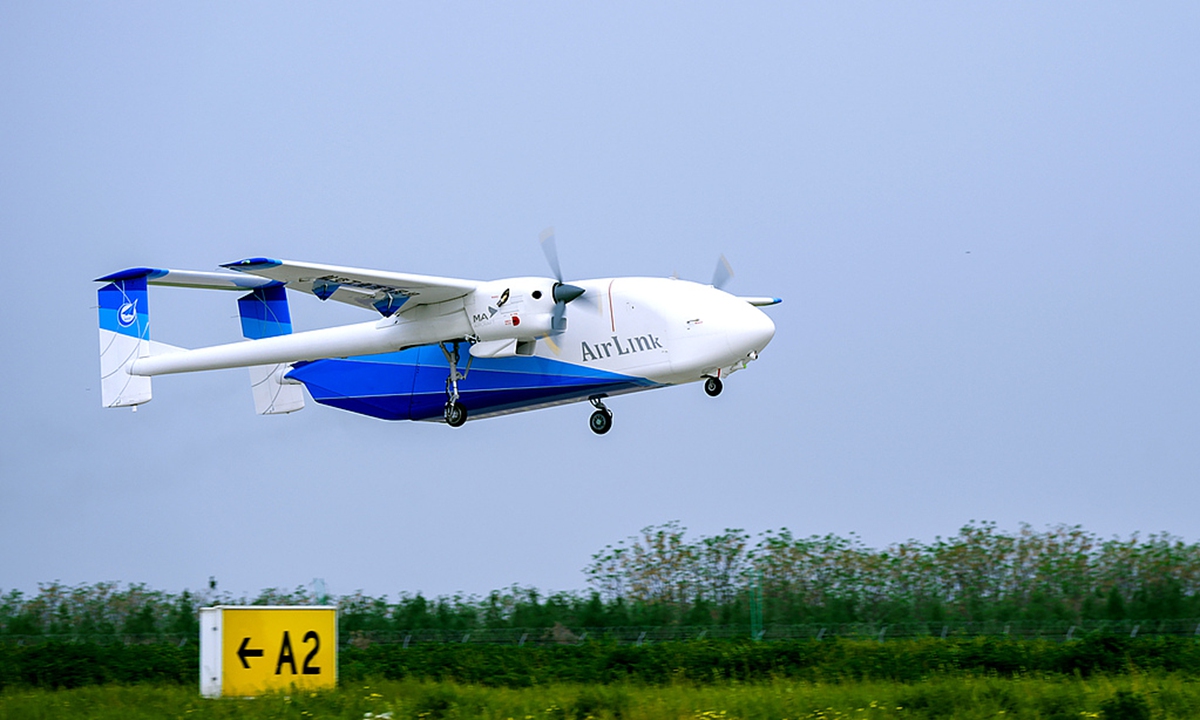
The "flying truck" nickname is more than just marketing; it describes a system designed for high utilization rates and rapid turnover. The fully enclosed, windowless cargo hold is equipped with electronic locking and rail systems that optimize ground loading and unloading cycles, potentially cutting ground-handling time by 40% compared to traditional bulk-load freighters. Furthermore, the development of multi-energy and new-energy variants alongside the current diesel-powered model suggests a long-term strategy to lower the carbon footprint of regional logistics. By utilizing graded composite materials to reduce weight while maintaining structural integrity under high aerodynamic pressure, the HH-200 achieves a cruising efficiency that is critical for maintaining a competitive price-per-ton-kilometer in the Southeast Asian inter-island transport market.
Looking toward late 2027, the potential commercial operation of the HH-200 could solve the "last mile" challenge for heavy cargo in remote border and coastal regions. The solution to scaling this technology lies in the integration of ground-based safety control networks that can manage hundreds of these units simultaneously. If the production costs follow the typical 15% to 20% reduction curve associated with scaled manufacturing, the HH-200 will likely dominate the middle-mile niche. This isn't just about aviation; it’s about a fundamental shift in the supply chain where autonomous flight becomes a standard utility, providing 24/7 logistical support with the same reliability as a ground-based trucking fleet, but at three times the speed.
News source: https://peoplesdaily.pdnews.cn/business/er/30052001842