
A refillable perfume bottle moves the quality problem from the juice to the hardware: repeat customers buy the refill, so the pump, the seal, the thread and the pressure balance matter as much as the scent itself. Custom perfume manufacturing for a refillable format therefore needs different checkpoints, in a different order, than a standard atomizer launch. This article lists the six checkpoints that decide whether your refill programme survives its second year.
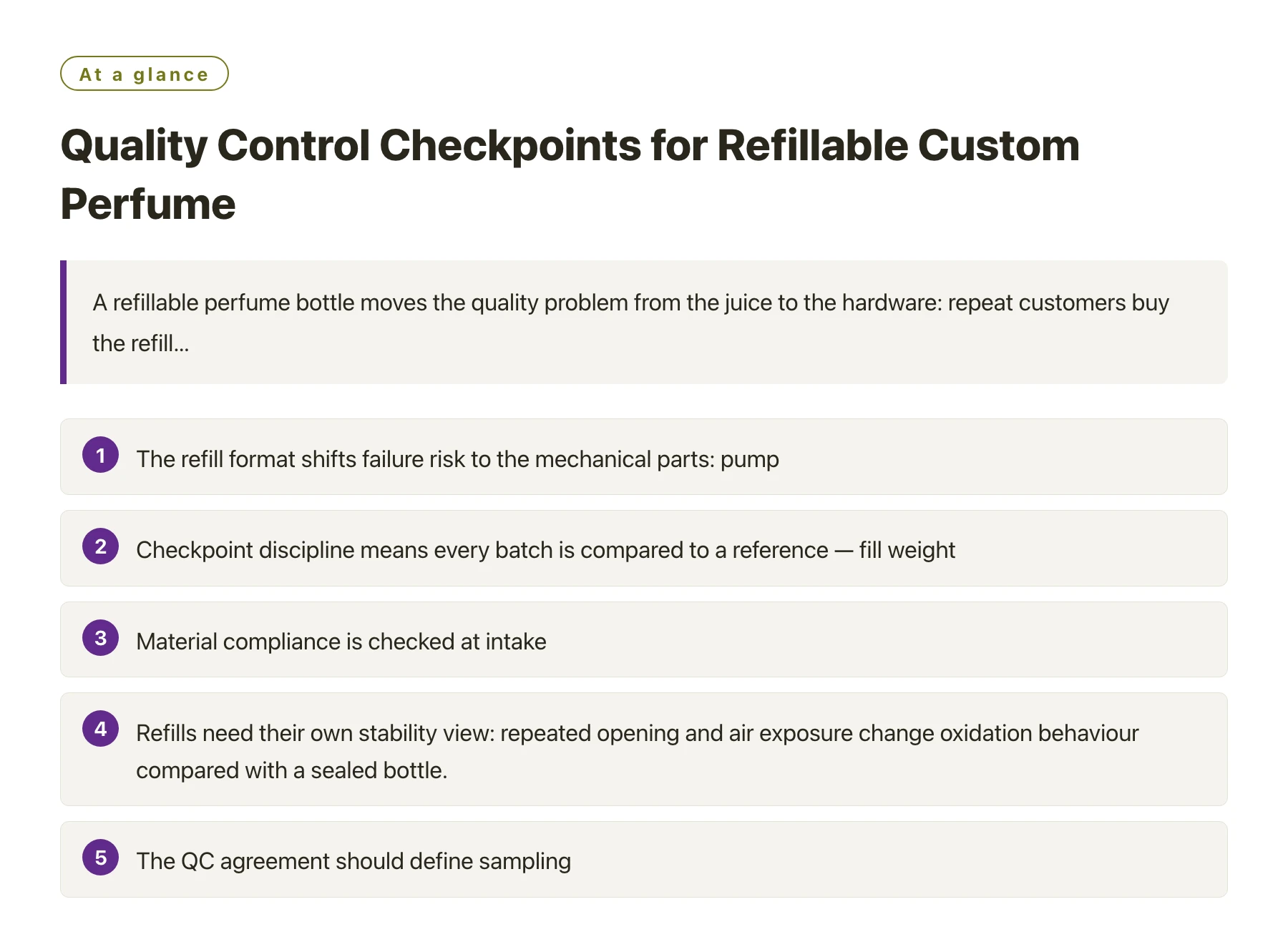
Key takeaways
- The refill format shifts failure risk to the mechanical parts: pump, seal, thread and the fit between refill and bottle.
- Checkpoint discipline means every batch is compared to a reference — fill weight, seal integrity, torque, spray pattern — not inspected once at approval.
- Material compliance is checked at intake, not at release: the compliance statement and the allergen declarations start from the raw material certificate.
- Refills need their own stability view: repeated opening and air exposure change oxidation behaviour compared with a sealed bottle.
- The QC agreement should define sampling, pass/fail criteria and the corrective loop in writing before production starts.
Refillable perfume sells a promise: the nice bottle stays, the juice gets replaced, and the environmental story improves with every refill. That promise lives or dies on mechanical reliability — a refill that leaks, strips its thread or sprays unevenly turns a sustainability feature into a return request.
For a manufacturer, refillable means new QC work: mated parts with tolerances, seals that survive many insertions, and a fill line that handles glass, inserts and pumps without damaging either.
What follows is the checkpoint map a product development lead should agree with the factory before the first production run, written for a custom scent in a refillable format.
Six checkpoints, in order
- Raw material intakeVerify every lot against its certificate — identity, purity, batch number — and capture the compliance picture that later feeds your label and dossier.
- Concentrate compoundingConfirm the batch matches the approved formula, usually by analytical profile against the reference, and record even small deviations.
- Dilution and filtrationCheck alcohol strength, mixing time and clarity; a haze or a drop in clarity here will not fix itself further down the line.
- Filling and headspaceFill weight within tolerance, consistent headspace, no leakage at the crimp or the thread — the moment most refill defects are born.
- Refill hardware and fitTest the refill unit against the actual bottle: thread torque, seal, insertion and removal cycles, and spray pattern through the full life.
- Release and retained samplesSign off only against the approved reference, keep retained samples from every batch, and archive the batch record for audit and for the next order.
What refill-specific testing adds
Two test runs that a conventional perfume might skip become essential with refills. The first is a compatibility soak: the juice sitting in contact with the pump gasket and the refill's plastic parts for weeks, because some fragrance materials interact with soft parts and can swell, discolour or stain them. The second is repeated-use ageing: a refill bottle is opened and closed dozens of times, each time admitting air, so oxidation behaviour differs from a sealed bottle. Ask for stability data that includes opening cycles, not just static storage.
None of this is exotic. A custom project at a serious manufacturer is judged the same way whether the format is standard or refillable: is each checkpoint written into the quality agreement, or is it left to memory? A Xuelei custom perfume manufacturer in China handles refillable formats as part of its production mix, but the difference between good and risky partners is not the brochure — it is whether the checkpoints above exist as documents you can sign.
Where compliance meets the label
The same material file that powers safety testing in perfume manufacturing — material restrictions, restricted-ingredient checks, allergen declarations — also generates the label and the safety dossier for your market. Collect it at raw material intake, because retroactively reconstructing a compliance file from retail stock is miserable and error-prone. Material identity checks at intake lean on reference databases, such as the Good Scents Company, that compile odour character and safety data for thousands of fragrance materials [1].
Compliance files go stale on a schedule. IFRA's standards are amended on a regular cycle, and the allergen list has grown in successive changes, so a formula documented five years ago may need a fresh declaration today [2]. When new safety questions appear, the scientific committees that advise regulators issue opinions that later flow into restricted-substance lists [3] — the compliance file has a best-before date too.
GMP discipline is the container for all of this: a cosmetics GMP framework such as ISO 22716 keeps intake, production and release traceable, which is what makes the checkpoints above auditable by you and by any third-party testing house you hire [4].
Put the QC agreement in writing before the mould is cut: the sampling plan (how many units per batch), the pass/fail criteria for each checkpoint, the retained-sample policy, and the corrective loop when a batch fails — who is told, who decides, who pays. Refill programmes fail on ambiguity, not on malice.
Sources
- The Good Scents Company —— A reference database of aroma materials with odour descriptions, CAS numbers and typical usage information.
- IFRA Standards Library (International Fragrance Association) —— The IFRA Standards Library lists the restrictions the fragrance industry applies to individual fragrance ingredients, based on safety assessments; it is the reference point for compliant fragrance formulation.
- EU Scientific Committee on Consumer Safety (SCCS) —— The EU scientific committee that issues opinions on the safety of cosmetic ingredients, including fragrance allergens and their labelling thresholds.
- SGS: Cosmetics, Personal Care & Household Testing —— Testing, inspection and certification services for cosmetics and personal care, including microbiological, stability and safety testing aligned with cosmetics GMP.
Frequently asked questions
What breaks first on a refillable bottle?
Usually the seal or the thread: a gasket that softens in contact with the juice, or a thread that strips after a few insertions. Both are caught by torque, soak and cycle tests — which is why those tests belong in the QC agreement rather than being discovered later.
Do refills need their own stability tests?
Yes. The juice in a refill sits in the bottle longer and is exposed to air on every opening, so oxidation behaviour differs from a sealed perfume. Ask for stability data that includes opening cycles and at least one refill change.
How many units should be sampled per batch?
As many as the agreement says — the number depends on batch size and the criticality of the failure mode, and the QC agreement should state it in advance. For refill hardware, sample more, because a mechanical defect repeats across every unit in the batch.
Can the same juice go in the refill and the atomizer?
Often, but not automatically: the refill is exposed to air and to different materials, so verify compatibility and oxidation with the refill package specifically rather than assuming the spray version's data applies.
What is in a certificate of analysis?
The measured values for the parameters the agreement defines — odour and appearance against the reference, fill weight, and the relevant physico-chemical checks — with batch number, dates and signatures. A certificate that lists parameters but no numbers is a form, not evidence.